Rassie Erasmus said tries were 'not the only thing that wins you matches' after leading the series 2-1 despite scoring eight tries to New Zealand's 13.
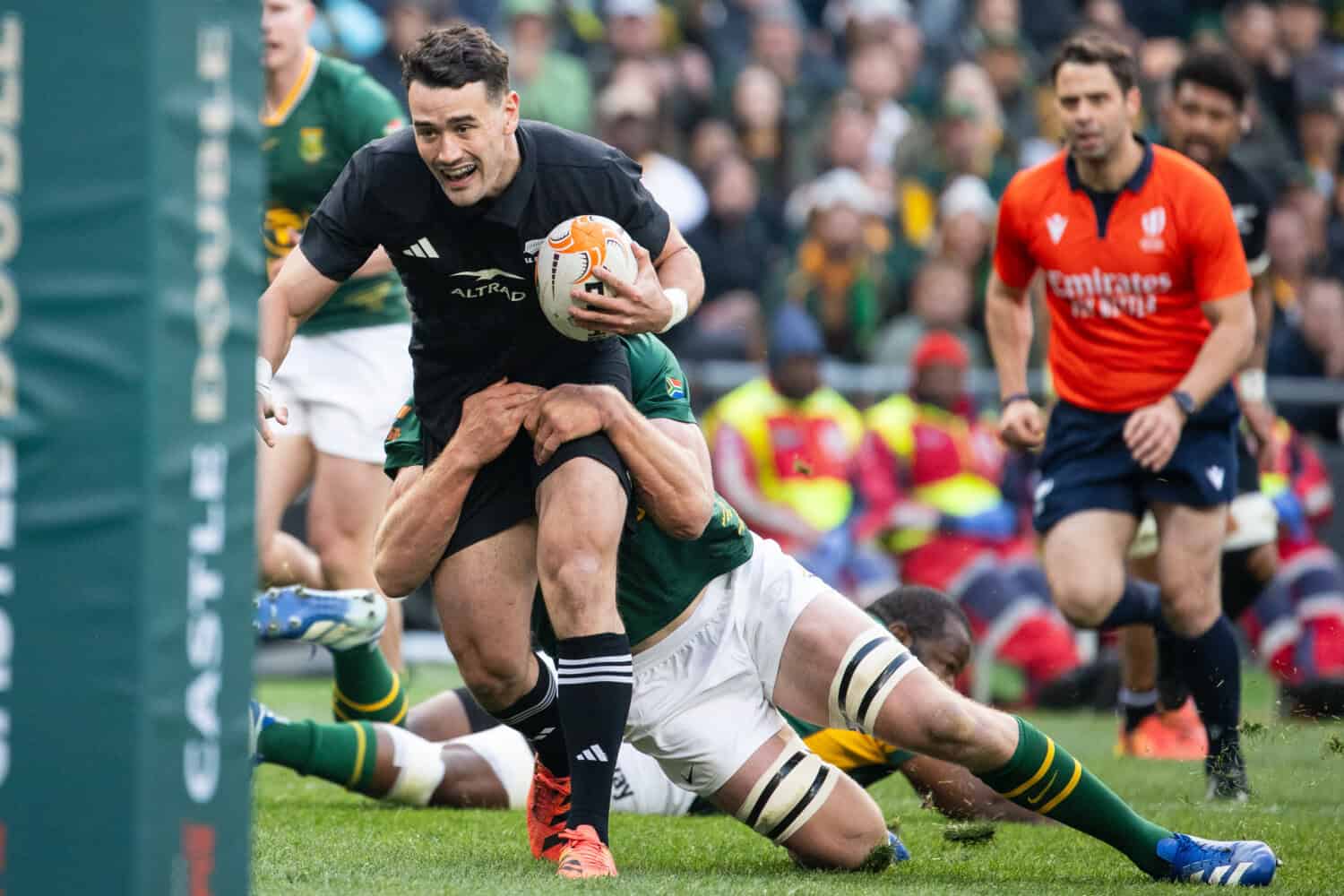
All Blacks wing Will Jordan has scored three tries against the Springboks in the series, along with his injured captain Ardie Savea. Picture: Floris van Schouwenburg/Gallo Images


The Springboks, who go into the fourth and final Test with a 2-1 lead despite scoring only eight tries to the All Blacks’ 13 in the first three games, say defence will again be crucial in Baltimore.
The teams play the final Rugby’s Greatest Rivalry Test in the United States after the All Blacks won 33-16 (five tries to one) in Ellis Park while the Springboks bounced back 33-26 in Cape Town (three tries to four) and 29-24 (four tries apiece) in Soweto.
New Zealand have scored 83 points to the Springboks’ 78, with Ardie Savea and Will Jordan leading the charts with three tries each.
Springbok head coach Rassie Erasmus had spoken of how defence had to improve ahead of the last clash at FNB Stadium, which it did even though fullback Cheslin Kolbe went off in the ninth minute due to injury, and the backline had to be reshuffled, with Manie Libbok coming on at flyhalf and Sacha Feinberg-Mngomezulu moving to fullback.
After naming his team for Saturday’s series decider on Monday night, Erasmus said his side had not improved in defence so much as they learned from their first Test against the All Blacks.
Especially in how they handled the breakdown, the All Blacks’ tempo, and defence in the wider channels.
‘Not the only thing that wins you matches’
“When the All Blacks make a line break, they have helluva speed,” Erasmus said.
“That’s the game they promote and obviously a lot of their training time – not that I know, we can just feel it on the field – goes into attack.
“They can certainly cut you apart and score some awesome tries. They’ve been outscoring us constantly with tries. Luckily that’s not the only thing that wins you matches.”
He argued that a penalty kick only yielded two fewer points than an unconverted try – something they learned the hard way after entering the New Zealand 22 many times through to scrum dominance in the first game, but failing to come away with points.
Young Springboks match All Blacks’ energy
“Then again, I don’t think there is a defence system that they will not breach the way they are playing,” Erasmus added of the All Blacks’ attack.
“The scramble defence becomes really important. Our guys can fight back and try to get a ruck where you can stop their offloads and great running skills.”
He said fast players under 30, such as Feinberg-Mngomezulu, Damian Willemse, Ethan Hooker, Grant Williams and Morné van den Berg, bring energy and speed to the scramble defence.
Many of the older Springboks can keep up. They also bring calmness to the defence, and both speed and composure were important, Erasmus said.