Ekurhuleni, Tshwane, and Joburg grapple with billions in unpaid bills, escalating provincial debt and risking essential services for residents.
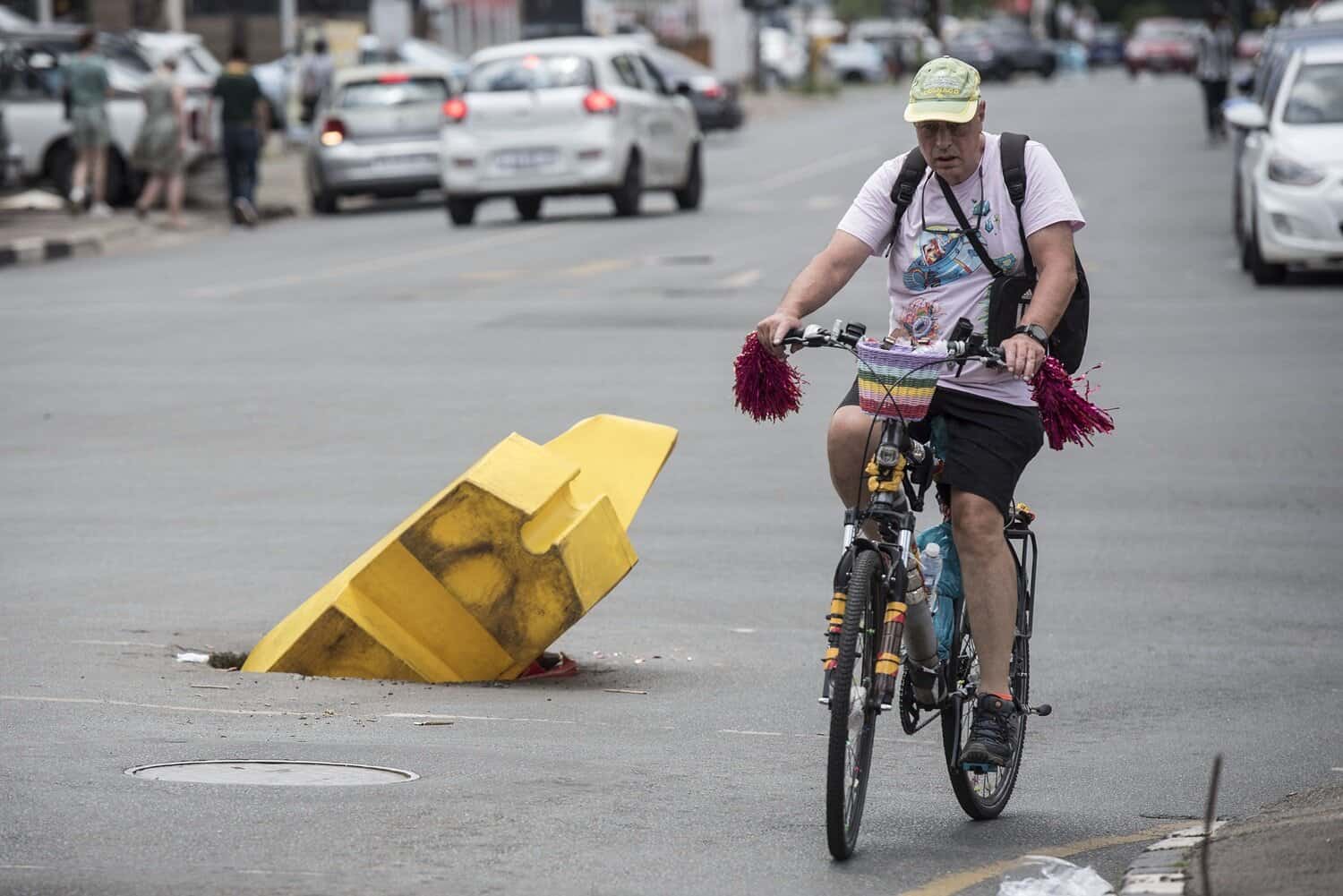
A cyclist passes a massive hole in the road at the intersection of Queen Street and Langerman Drive in Kensington, Johannesburg, last month. Picture: Michel Bega


Gauteng’s ballooning municipal debt has exposed a dangerous cocktail of political failure, billing chaos, lax accountability and an entrenched culture of non-payment of basic services, fuelling fears that municipalities are edging towards financial collapse.
The debt burden means that, down the line, someone is going to have to cough up. It will either be ratepayers and consumers, in the form of increased service charges and levies; or municipal and even provincial projects have to be curtailed through the lack of cash.
Disturbingly, as revealed this week by Gauteng MEC for finance and economic development Lebogang Maile, councillors and municipal officials alone owe a combined R165.7 million of the estimated R167 billion outstanding to municipalities.
R165m: How much government employees owe in rates and taxes
However, the MEC, the executive authority in charge of all provincial money matters, dropped the bombshell and then seemingly went underground, sidestepping critical accountability and enforcement questions on the municipalities’ failure to collect municipal services debt.
Maile’s spokesperson, Onwabile Lubhelwana, said they “merely made a report public” and that questions be directed to the cooperative governance and traditional affairs department (Cogta) and municipalities.
ALSO READ: Jab today, save lives tomorrow: Gauteng rolls out HPV vaccine
“The MEC is highly committed and the schedule doesn’t give us an opportunity to continue with more interviews on this item,” Lubhelwana said.
Asked whether this meant that the MEC for finance was effectively limited to a reporting role and unable to act, Lubhelwana said: “There are various controls Treasury puts in place, complying with expenditure policies, the Municipal Finance Management Act and other regulations.
“However, due to the competing priorities. We are really over subscribed this month. Our diary is full.”
Joburg – R74m, Tshwane – R36m, Ekurhuleni – R22m
According to Maile, as at 31 December, Johannesburg recorded the highest outstanding amount at R74.8 million, followed by Tshwane with R36.2 million and Ekurhuleni at R22.9 million.
While households and businesses account for the bulk of municipal debt, largely for electricity, water and property rates, the Organisation Undoing Tax Abuse (Outa) said the presence of public officials among defaulters reflects a deeper governance failure.
ALSO READ: Will the skies behave? Gauteng’s weekend forecast
Outa CEO Wayne Duvenage described the situation as unacceptable, saying municipal leadership lacked the political will to enforce accountability.
He argued that this was not a complex problem; it simply requires political will. Duvenage linked household debt to inaccurate billing, weak debt management and poor systems.
“It just requires political will and leadership that should firstly not have allowed this situation to arise in the first place, but also not able to address this situation [from getting] worse.
‘Unacceptable’ – Outa
“When it comes to household debt, again, this is indicative of poor municipal management and inaccurate or inefficient systems, both of which do them no favours to manage debt professionally and efficiently,” Duvenage said.
He argued that if any business operated like this, it would be out of business.
ALSO READ: Johannesburg Roads Agency responds to residents’ complaints with rapid repair plan
DA Gauteng finance spokesperson Ruhan Robinson said weak credit controls and a lack of political accountability had allowed the crisis to escalate.
“This amount of debt has been allowed to escalate due to weak credit control and financial systems. While [most of] this debt is owed by officials, it is the politicians that decry the pervasive ‘culture of non-payment’.
“It is unethical and leaders need to lead by example,” he said.
‘Leaders need to lead by example’ – DA
Robinson said municipalities ought to put enforcement measures in place immediately and that each defaulting official and councillor must sign an acknowledgment of debt and arrange to settle their outstanding amounts.
The Forum for South Africa (Fosa) also expressed grave concern, particularly over reports that Soweto residents owe nearly R5 billion in unpaid municipal and electricity bills.
ALSO READ: Lesotho Highlands project: More water coming to Gauteng, but it doesn’t mean taps won’t run dry
Fosa leader Tebogo Mashilompane said revelations that councillors and officials were themselves in arrears severely undermined public trust.
“This crisis did not arise overnight. It is the result of a long-standing culture of non-payment.”
Support Local Journalism
Add The Citizen as a Preferred Source on Google and follow us on Google News to see more of our trusted reporting in Google News and Top Stories.