



New agreements and shared development priorities are reshaping economic cooperation between India and Africa.
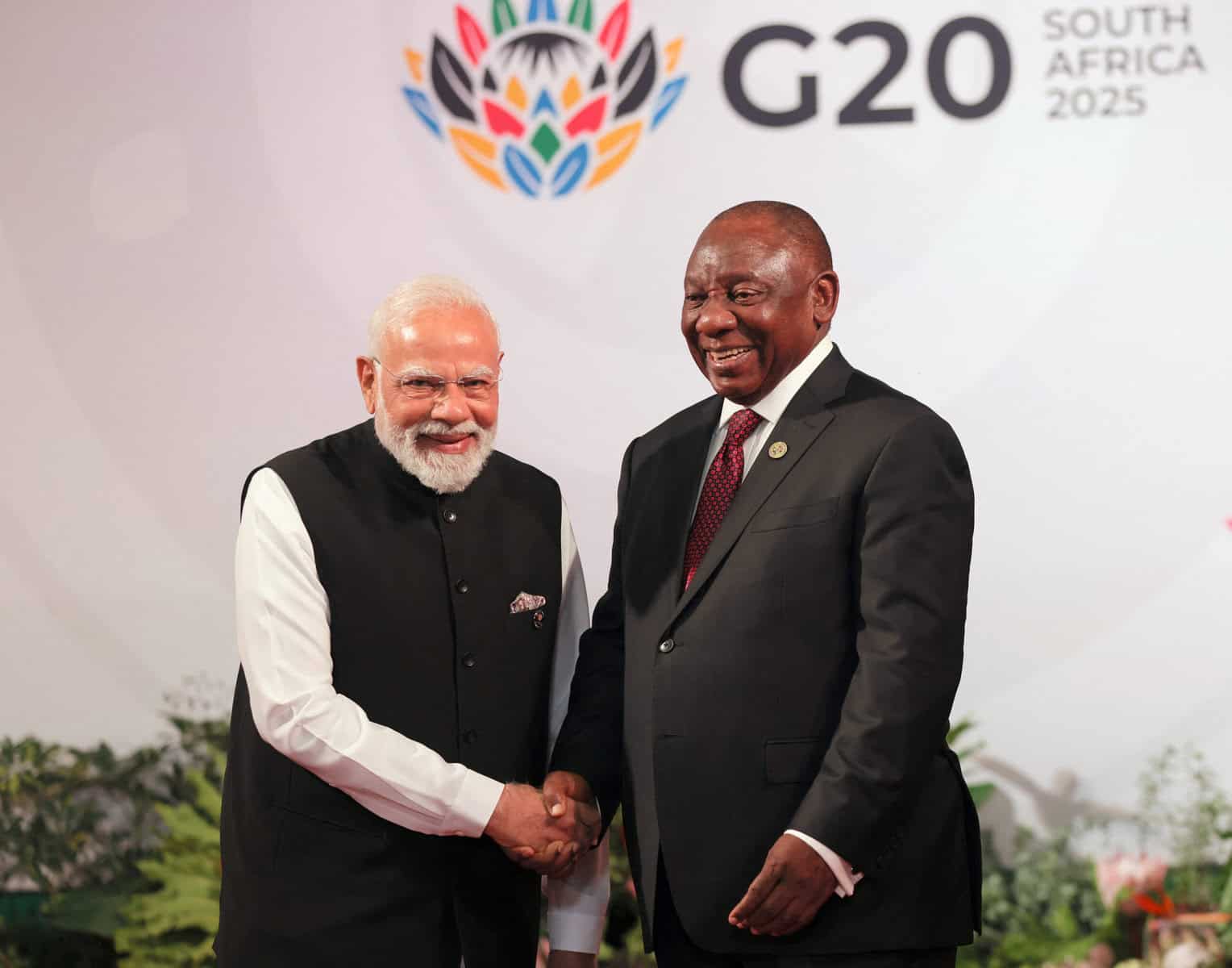
South African President Cyril Ramaphosa (R) welcomes Indian Prime Minister Narendra Modi as he arrives for the opening of the G20 Leaders’ Summit at the Nasrec Expo Centre in Johannesburg on November 22, 2025. Picture: Halden Krog / Pool / AFP


Indo-African trade relations are set to continue on a robust trajectory in the aftermath of the G20 summit in Johannesburg.
India is the continent’s third-largest trading partner and fourth-largest investor, and trade between them has grown from $5 billion (about R85 billion) in 2002 to nearly $100 billion in recent years, despite lingering imbalances.
The Johannesburg G20 agenda had a strong south-south bias, with issues confronting the developed world, including Africa, taking centre stage.
India’s support, shared expertise and diplomatic muscle ensured the continuity of the African agenda, moving it from the periphery to the core of the discussions.
Prime Minister Narendra Modi, a key player batting for Africa, proposed initiatives to build capacity and foster development, including a G20-Africa Skills Multiplier Initiative to prepare one million certified trainers in Africa over the next decade.
His Critical Minerals Circularity Initiative focused on strengthening supply chains for critical minerals through recycling and urban mining, in alignment with Africa’s mineral resources and climate goals.
ALSO READ: SA must Modi-fy to beat propaganda ahead of G20 2026
The upshot of the G20 initiatives will be increased trade and cooperation between India and Africa, underpinned by increasing diversification beyond raw materials into pharmaceuticals, automobiles, agriproducts and digital services, with future potential in green energy and technology.
Indian government initiatives, such as its Duty-Free Tariff Preference Scheme for Africa, will play an important role in deepening this economic integration and shared growth.
India’s key imports from Africa are energy and minerals, while its exports have diversified into high-value goods including medicines, vehicles, machinery and food products.
There has also been a steady growth of Indian investments in the continent across sectors such as mining, pharmaceuticals, IT and infrastructure.
India’s expertise in digital public infrastructure, together with the African Continental Free Trade Area, have opened up new opportunities for Indian businesses, while forums such as Brics and IBSA (India, Brazil, South Africa) are further strengthening economic ties.
Among the challenges are a persistent trade deficit due to India’s reliance on energy and mineral imports from Africa.
ALSO READ: G20 overwhelmingly adopts a Leaders’ declaration without the US
On the other hand, Africa needs to move beyond producing raw materials and minerals for export to becoming a manufacturer of finished products.
The deepening Indo-African commercial ties have positive spin-offs for South Africa.
It has long been India’s main trade partner and largest trading partner in the African region.
Trade between the two countries stood at $19.25 billion in 2023-24, and following bilateral talks between President Cyril Ramaphosa and Modi on the sidelines of the Johannesburg G20 summit, the economic ties are set to strengthen further.
The prospect of ever closer Indo-African trade relations bodes well for their economies, coming amid the turmoil and uncertainty caused by the US tariff war, which has sent many countries scrambling for new markets and trade partners.
NOW READ: China backs South Africa amid Trump’s G20 threats
Support Local Journalism
Add The Citizen as a Preferred Source on Google and follow us on Google News to see more of our trusted reporting in Google News and Top Stories.

