Multi-million dollar investment in former Nissan facility will see first cars roll off assembly line in 2027.
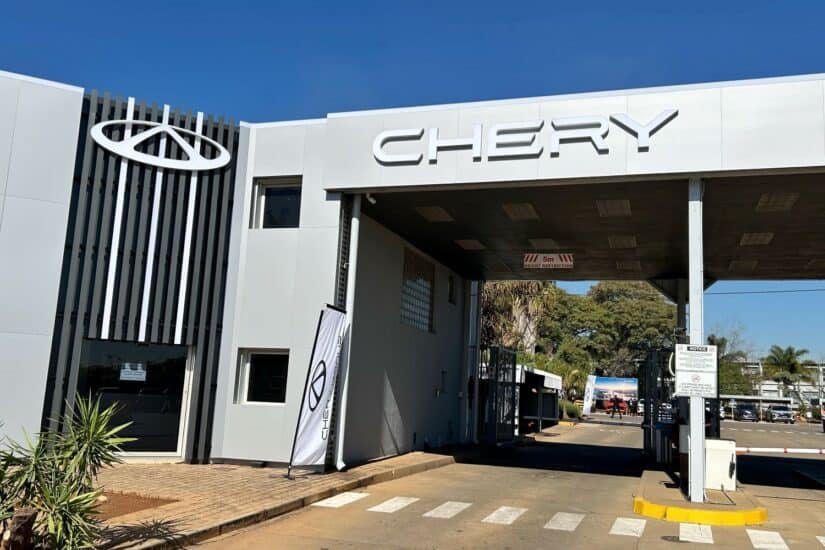
The Rosslyn assembly plant enters a brand new era, albeit under a new brand. Picture: Jaco van der Merwe


Chinese carmaker Chery on Friday reiterated its commitment to the long-term future of the South Africa vehicle manufacturing industry during its official takeover of the Rosslyn assembly plant previously owned by Nissan.
Established in 1963 by Nissan, the Rosslyn plant outside Pretoria has for over six decades been a key facility in local production, which is estimated to generate over 5% of the country’s GDP (gross domestic product). Nissan sold the factory to Chery and will now import the Nissan Navara, the last vehicle it built there, as part of its ongoing local operations.
As part of the sales agreement, Chery will keep 692 of the work force previously employed by Nissan, while the manufacturer also plans to create a further 3 000 new jobs through the plant’s multi-million dollar upgrade. Its aim to source 40% local content will also create thousands more jobs down the supply chain.
Chery targets all of Africa
The investment forms part of Chery’s broader vision to establish South Africa as its African manufacturing, export, research and development and operational headquarters. In the process, Chery is committed to creating a full industrial chain ecosystem, spanning from raw materials to end products, while honouring its environmental and corporate social responsibilities.
“At Chery, we live by one philosophy. In somewhere, for somewhere, be somewhere. It means wherever we invest, we commit,” said Yin Tongyue, chairman of Chery Automobile.
“We become part of the local economy, part of the community, part of the country’s future. We have moved from being an importer to a manufacturer – and from a market participant to a long-term partner in South Africa’s industrial story.”
Gauteng Premier Panyaza Lesufi said that the handover between manufacturers marks an historic moment for the industry and country.
Smooth takeover lauded
“Today is a defining moment for South Africa’s automotive sector and an important milestone in the evolution of the Rosslyn manufacturing facility. This transition lends itself to opportunity rather than closure, ensuring that an important industrial asset remains productive and continues to contribute to the economy,” said Lesufi.
“We appreciate the smooth transition of the almost 700 employees that came with decades of experience. The fact that you were so willing to absorb these workers makes it clear that you intent to stay forever.
“We don’t just celebrate chance in ownership. We celebrate continuity and renewed investment.”
Founded in 1997, Chery Group is a diversified enterprise group with the automotive industry at its core. Its business spans more than 130 countries and regions worldwide, and it has ranked first among Chinese-brand passenger vehicle exporters for 23 consecutive years.
Chery shoots for the stars
After an ill-fated local stint that ended more than 15 years ago, Chery returned to South Africa in 2021 with a bang. Cumulative sales across the Chery range and sub brands Omoda, Jaecoo, Jetour, iCaur and Lepas saw the carmaker become the second-largest local passenger vehicle manufacturer after long-standing market leader Toyota in the first half of this year.
Chery aims to start building cars in the second half of 2027 and set themselves the lofty goal of producing 50 000 vehicles in Rosslyn in 2028. While a part of the production output will be allocated to export, Chery hopes the number it will put them in good stead in their goal of selling 100 000 cars locally annually.
“While the amount we paid for the plant is confidential, we can say that we need to invest hundreds of millions of dollars in upgrading the plant before it’s ready,” says Charlie Zhang, vice-president of Chery Automobile.
“And that is only the initial investment, after which the plant will require constant upgrading as model production changes.”
Four models already confirmed
Chery has not yet confirmed the entire line-up of models it plans to build in South Africa. Confirmed thus far for Rosslyn assembly is the Jetour T1 and T2, Jaecoo J5 and Chery Tiggo Cross .
“There are several different scenarios like the production capacity and the levels of automation required for the models we are going to produce. We are busy doing the analysis to optimise the product portfolios we want to produce here,” added Zhang.