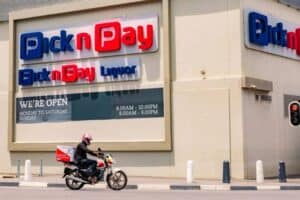
The group halved losses in its core supermarket business from R1bn to R516m during the six-month period.
Pick n Pay. Picture: Supplied


Pick n Pay narrowed its loss in the half-year to 30 August by 56.3% to R139 million, with minimal growth in volume in Pick n Pay sales as the group struggles to turn the loss-making retailer around.
Turnover in Pick n Pay stores was down 0.5% – in part due to a reduced number of stores – with six closing in the half-year. The group managed to halve losses in the Pick n Pay business from R1 billion in the prior period to R516 million.
In total, 12 Pick n Pay stores have closed in the full year.
Pick n Pay owns a roughly 53.1% stake in Boxer, the profitable discounter, and said the group’s increased trading profit of R490 million before tax, finance costs and capital expenditure, up 58.1% was driven by a R75 million increase in Boxer trading profit and the substantial reduction in Pick n Pay losses.
Price inflation was 1.5% – below the Stats SA figure for the period of 2% – with Pick n Pay saying this reflects its “commitment to deliver low prices to customers”.
It saw like-for-like growth in company-owned Pick n Pay stores of 2.4%. Taking into account price inflation, there was real growth of 0.9%, with the group admitting “stronger growth is required and Pick n Pay is striving to deliver this”.
Pick n Pay said within the context of the intense pressure facing consumers, particularly since the May 2026 fuel price hikes, and similar growth levels at competitors, “the company-owned supermarkets’ outcome is satisfactory”.
Pick n Pay franchise supermarket sales growth was up 1%, which means after taking into account price inflation, volume growth went backwards by 0.5%. It said it was continuing to improve franchise profitability and drive sales.
Pick n Pay faces intense pressure from the Checkers’ on-demand delivery service Sixty60, which delivered R25.5 billion in sales in the 2026 financial year, albeit over a different reporting period.
Pick n Pay has been in discussions about retrenchments and reduced pay for 22 000 employees since May and last week announced it has finalised this process with its main union, the South African Commercial, Catering and Allied Workers Union (Saccuwu).
It said on Monday, “The agreement introduced a simplified and more competitive store labour model that supports more flexible and effective labour scheduling, improved cost management and a stronger long-term position for Pick n Pay’s core supermarket business.”
“We are pleased that we have reached agreement through the formal consultation process. This puts us on a more competitive footing, helps secure jobs, provides greater certainty for our employees and creates a stronger platform for future growth.
“We extend thanks to all involved for the constructive and respectful nature of the engagement, which is a testament to the strength of the relationships we have built over time,” says Pick n Pay CEO Sean Summers.
Pick n Pay says the agreement marks the latest achievement in the six-point strategic turnaround plan set out two and a half years ago.
“Other priorities achieved include the successful recapitalisation of the business, the completion of a store estate reset to address loss-making stores, the strengthening of key partnerships to enhance the customer offer and drive innovation, and the implementation of leadership succession plans. Last month, Pick n Pay announced Spencer Sonn as CEO-designate, who will join the business next year.”
The group aims to break even in its 2029 financial year.
Otto 1890 analyst Alec Abraham says the results were in line with his expectations. “That is, they show the ongoing successful execution of the strategy of aggressive store rollout and improving scale efficiencies and improving profitability. What the results also show is the pressured consumer environment.”
He adds that since Summers started as CEO, he has maintained Pick n Pay will be profitable again as Summers fixes the business but he says Pick n Pay will not recover all lost market share to Woolworths and Checkers.
Other highlights
Trading profit margin: 0.8% up from 0.5%
Headline loss: R299 million down from a loss of R439 million
Headline loss per share (Heps): a loss of 40.71 cents but 31.9% lower than prior period.
This article was republished from Moneyweb. Read the original here.