
When will the elections be? Registration weekend announced as IEC awaits proclamation
South Africans are still waiting for an official election date, but the IEC says that once it is announced, the window to register will close at midnight.

The Electoral Commission of South Africa (IEC) has called for an early announcement of the date for the Local Government Elections, as it is the view of the commission that this is critical for citizens to decide where they will be on voting day.
This is according to chief electoral officer Sy Mamabolo, who this morning addressed the media on the IEC’s readiness for the upcoming elections.
Mamabolo said voters need to know where they will be, to determine where they register. He used the example of a student studying in one province, but living in another. “In a local government election, there is no facility to vote outside of the voting station of registration,” he emphasised.
Once the Minister of Co-operative Governance and Traditional Affairs, Velenkosini Hlabisa, officially announces the election date, the window to register closes almost immediately. Eligible voters have only until midnight on that same day to get onto the roll; if you miss this deadline, you will not be able to vote in this election.
The proclamation of the Election Day date will officially start the activities needed to prepare for the election. These include:
- The certification and publication of the voters’ roll
- Inspection of the voters’ roll and the lodging of objections
- Consideration and adjudication of objections by the commission
- Submission of candidate nominations and the applicable cut-off deadlines
Mamabolo said that talks with the minister are at an advanced stage and that he hopes a date will be announced in the ‘not too distant future’.
The elections must take place between November and the end of January 2027, per the Constitution, which Mamabolo concedes is not an ideal period, given the November school exams and the festive period.
Asked if Hlabisa, who is also the leader of the IFP, holds an unfair advantage in terms of planning, Mamabolo emphasised that the minister makes this decision from a non-partisan position and not as the leader of a political party.
Voter registrations
While a voter registration weekend will take place on June 20 and 21, a steady increase in the number of citizens using the online self-registration platform has been noted. According to Mamabolo, more South Africans are also taking advantage of outreach initiatives to register and update their details.
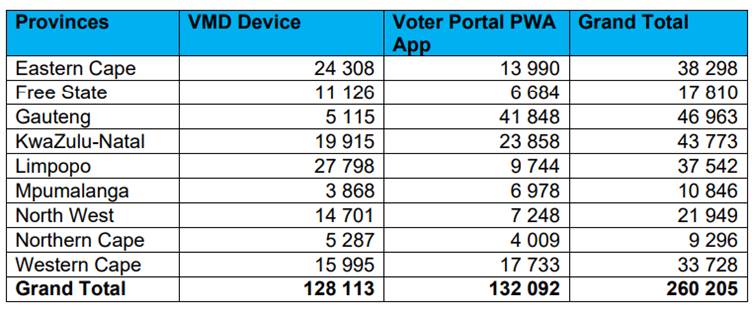
“Between November 2025 and March 2026, 260 205 new registrations were recorded on the online voter registration campaign,” he added. Asked about concerns over foreign nationals and voting, Mamabolo said the IEC checks people’s details with Home Affairs before adding them to the voters’ roll, which currently has 27 million names.
He said the commission is committed to an ‘incident-free’ registration process and a ‘smooth and efficient’ voting day.
The IEC’s voter education drive runs year-round and has:
- Reached more than 3.43 million people
- Held 18 000 community events across all provinces
- Reached an additional 830 223 people since a November 2025 briefing
Why do people not vote?
Deputy electoral officer Masego Sheburi spoke about why 10 million of the 27 million registered voters did not vote in the last elections, and why many young people often do not participate.
He said it is not always fair to call low turnout ‘apathy’. Their research shows that young people often do not vote because they are concerned about what is happening in the country. Sheburi said efforts to increase registration should be matched by the performance of democracy – in other words, people need to see the benefits of taking part in the system. Until that is addressed, participation among young voters is likely to stay low.
Sheburi added that research on why people vote or abstain will be published soon, and that the IEC will use this data to guide efforts to increase voter turnout.
Political parties
Twenty new parties were registered between October 2025 and February 2026, meaning there are currently 508 registered parties. Of these, 299 are registered on the national level, and 209 are either registered on provincial, district or metropolitan municipality level.
While Sheburi stated that having many parties is vital for a multiparty democracy, he expressed concern that the high number of participants makes the physical ballot paper too long.
Sheburi explained that some voters struggle to find their preferred party on a crowded ballot. This leads to common errors such as leaving the ballot blank, accidentally voting for a candidate with a similar name or marking too many boxes, which results in a spoiled and invalid vote.
Democracy is costly
The commission again made the call to individuals and corporate South Africa to make contributions to the Multi-Party Democracy Fund, which distributes private donations to represented parties.
Despite this, the fund has received no contributions for two consecutive quarters.
On the topic of funding, Sheburi said they had adequate funding to run ‘a proper election’ and that around 200 000 people will be employed on Election Day.
Ward boundaries and voting districts
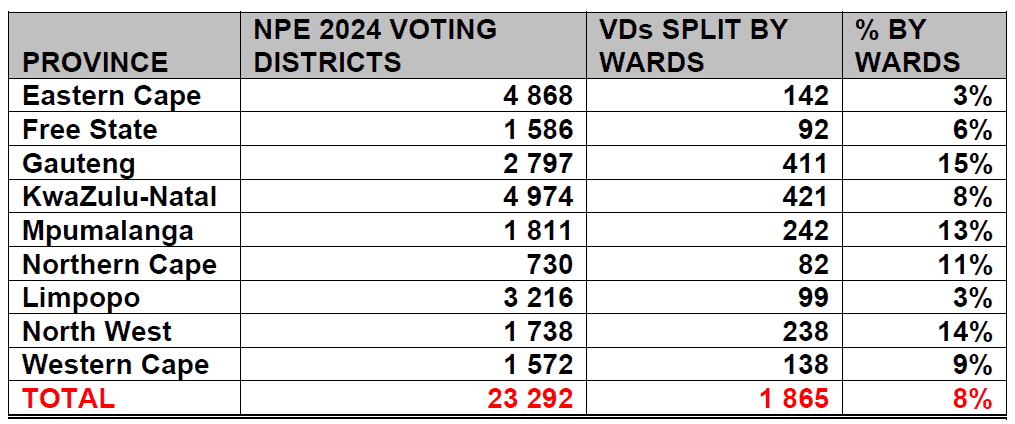
The Municipal Demarcation Board has completed nearly all local ward boundaries, handing over 4 305 wards – 95% of the national total – to the IEC. The remaining wards, in four KZN municipalities including eThekwini, are now being finalised after two court cases were resolved. The latest adjustments subdivided 1 865 voting districts (about 8% nationally), with KZN and Gauteng accounting for nearly half of the affected districts. Ward boundaries determine local political representation, while voting districts are used to organise voter registration.
Safety
Concerns have been raised about election safety. In the 2021 elections, more than 300 high-risk areas were identified. This comes amid a rise in community protests over service delivery.
Mamabolo confirmed that election security is being managed by a specialist committee co-chaired by the IEC and SAPS. This group is already meeting to identify hotspots and plan necessary police deployments. While he admitted that disruptions are possible, he emphasised that it is the police’s responsibility to protect voters, staff and the integrity of the voting process.
Also read: Beware of election scams: IEC warns of fake sites and deepfakes
Watch the briefing:
Breaking news at your fingertips… Follow Caxton Network News on Facebook and join our WhatsApp channel.
Nuus wat saakmaak. Volg Caxton Netwerk-nuus op Facebook en sluit aan by ons WhatsApp-kanaal.
Read original story on www.citizen.co.za

