
Watch: Cape Town fights for powers to help put more criminals behind bars
After years of unsuccessful requests, the Mother City has formally challenged the national government in a bid to secure investigative powers for metro police alongside SAPS.
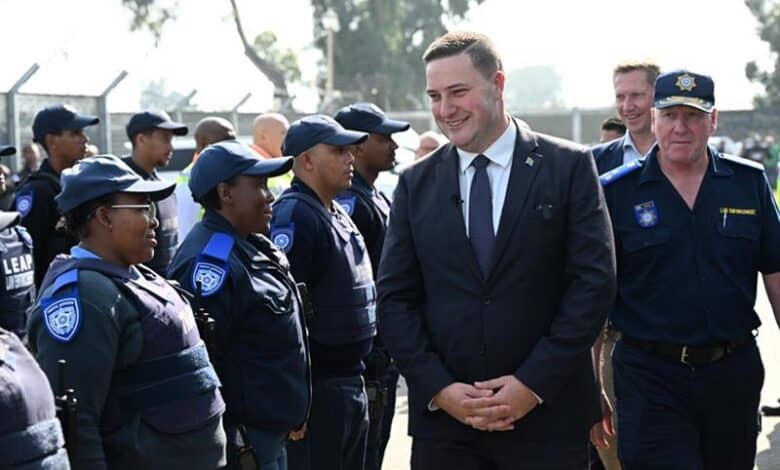
Cape Town Mayor Geordin Hill-Lewis has declared an intergovernmental dispute with Acting Police Minister Firoz Cachalia, accusing the national government of delaying efforts to expand the investigative powers of the city’s metro police officers.
Hill-Lewis announced the move yesterday (August 3) at the city’s Bishop Lavis Law Enforcement Advancement Plan (LEAP) base, saying the dispute followed years of unsuccessful attempts to persuade the national government to grant metro police officers greater crime investigation powers.
The city said it formally declared the dispute after several unsuccessful attempts to resolve the matter through discussions.
‘Stonewalled’ over five years
Hill-Lewis claimed the city had been ‘stonewalled’ over the past five years in its efforts to expand the investigative powers of the metro police.
In 2022, the city sent then police minister Bheki Cele a comprehensive motivation and proposals outlining the request, but received no response.
He claimed the city had engaged successive police ministers over several years and wrote to Cachalia immediately after he was sworn in last August.
“At the acting minister’s request, we submitted detailed proposals for policing power regulations in addition to those that had already been issued for public comment. This led to several follow-up letters and engagements.”
Hill-Lewis said he was hopeful progress was being made and wrote to Cachalia again in February to request an urgent way forward.
“The acting minister wrote back in April stating that an SAPS Act amendment would be needed, but failed to include this in the bill [SAPS Amendment Bill] he recently tabled in Parliament. This was yet another opportunity squandered, which has now led to us lodging this dispute,” said Hill-Lewis.
Mediation requirement
The dispute, lodged under the Intergovernmental Relations Framework Act (13 of 2005), will require both parties to enter mediation in an effort to resolve the matter without going to court.
“We refuse to accept that communities must live in daily fear of gang, gun and drug crime. The time has come to catch and convict, which our metro police stand ready to do in support of SAPS and the NPA,” added Hill-Lewis.
He said all available policing resources in Cape Town should be used to their fullest potential, adding that SAPS was under pressure to combat violent crime with limited resources.
“Put simply, when a metro police officer confiscates an illegal gun, and we take around 400 of these off the streets annually, the city should be empowered to build a successful docket for prosecutors to gain a conviction,” he explained.
Broken justice system
Hill-Lewis said under the current system, metro police officers hand illegal firearms over to SAPS, but claimed only 5% of these cases result in convictions due to what he described as a broken criminal justice system, forcing officers to repeatedly police the same offenders.
He added that, if all parties could agree on the necessary amendments to the SAPS Act (68 of 1995) through formal dispute mediation, a good-faith solution could be reached that would avoid the courts and put the interests of Cape Town residents first.
Constitutional framework
He added that the Constitution provides for policing functions to be exercised in the local government sphere where appropriate, but that the SAPS Act does not currently provide metro police with investigative powers.
“Section 205 of the Constitution says that the SAPS Act must establish a framework for policing powers and functions to be discharged by a police service in the local government sphere ‘where this is appropriate’,” he said.
“We have demonstrated, over and over, that it is indeed appropriate here in Cape Town – that our metro police are prepared, resourced and ready to take on investigations for specific crimes.”
He said crime investigation powers could be expanded to metro police within months if the necessary SAPS Act amendments were achieved through formal dispute mediation and the current parliamentary process.
“If not, the city will seek a court order declaring section 64E of the SAPS Act unconstitutional,” said Hill-Lewis.
Support SAPS
Hill-Lewis said the city was not seeking to replace or compete with SAPS, but rather to work with police and prosecutors to build stronger cases and secure more convictions, particularly for gang, gun and drug-related crimes.
Alderman JP Smith, the city’s mayoral committee member for safety and security who was also at the announcement, said: “Our communities are bleeding, and if we can stop the flow of illegal firearms, we can significantly reduce violent crime. The ‘catch and release’ status quo must end.”
The SAPS Amendment Bill is expected to be discussed by Parliament’s Police Portfolio Committee tomorrow (August 5).
The Police Ministry was approached for comment. Its response will be included once received.
Watch the video here:
Breaking news at your fingertips… Follow Caxton Network News on Facebook and join our WhatsApp channel.
Nuus wat saakmaak. Volg Caxton Netwerk-nuus op Facebook en sluit aan by ons WhatsApp-kanaal.
Read original story on www.citizen.co.za

