
Tiny hatchling offers lifeline for SA’s vanishing white-headed vultures
A rare white-headed vulture chick has hatched in Pietermaritzberg, offering conservationists renewed hope for a species now nearing extinction in South Africa.
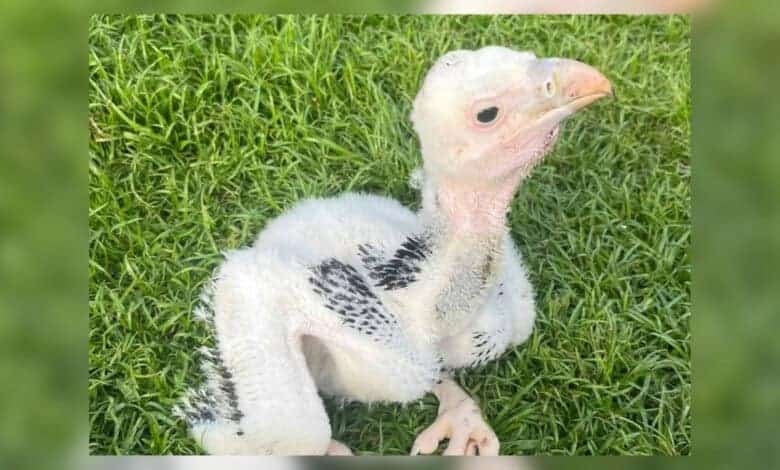
A tiny, featherless chick no bigger than a handful has given conservationists at the African Raptor Centre (ARC) in Pietermaritzberg renewed hope for a species on the brink of disappearing from South Africa’s skies.
According to The Witness, the critically endangered white-headed vulture hatchling, the first successfully raised at the centre since 2020, broke free of its shell on October 6 after externally pipping the day before.
ARC’s vulture specialist Dr Jacqui Gray said the team was ‘absolutely thrilled’ when the chick emerged.
‘A powerful victory for conservation’
“Seeing the tiny, pink, featherless chick wriggle free from its shell was both humbling and emotional. It felt like a small but powerful victory for conservation, proof that all the dedication, care and patience are worth it.”
Now five weeks old, he is growing steadily, with early feathers emerging and new milestones recorded daily.
Long-term breeding efforts
ARC, based in Tala Private Game Reserve, works with six adult white-headed vultures that arrived at the centre roughly two decades ago.
The birds form three breeding pairs, with genetic studies under way to determine whether their offspring may one day be suitable for release.
Collaboration remains central to these efforts, and a spare female was recently sent on a breeding loan to VulPro at Shamwari Game Reserve.
Species on the brink
Gray said the species’ status remains dire. “White-headed vultures have been listed as Critically Endangered since 2015. Their populations have suffered catastrophic declines due to poisoning, habitat destruction and persecution. In KZN, they are now functionally extinct, the last active nest was recorded in 2017.”
Current estimates suggest fewer than 120 individuals remain in South Africa. She added that for such a slow-breeding species, typically producing only one chick every one to two years, ‘every successful hatch and every chick that survives to adulthood represents a meaningful contribution to the future of the species’.
This season, all three breeding pairs laid eggs: One infertile, one chick that survived four days and now this healthy youngster.
Careful hand-rearing
Gray said the chick is being hand-reared under strictly controlled conditions to prevent mal-imprinting. Feeding takes place every four hours, temperature and humidity are closely managed, and every gram of weight gain is logged.
As the chick grows stronger, his survival offers rare good news for a species edging toward extinction, and a reminder, Gray said, that ‘persistence, partnership and public support can still turn the tide’.
Breaking news at your fingertips… Follow Caxton Network News on Facebook and join our WhatsApp channel.
Nuus wat saakmaak. Volg Caxton Netwerk-nuus op Facebook en sluit aan by ons WhatsApp-kanaal.
Read original story on witness.co.za

