
Jacob Zuma must pay back the money
The Gauteng High Court has declined Jacob Zuma’s bid to escalate his case to a larger panel or the Supreme Court of Appeal.
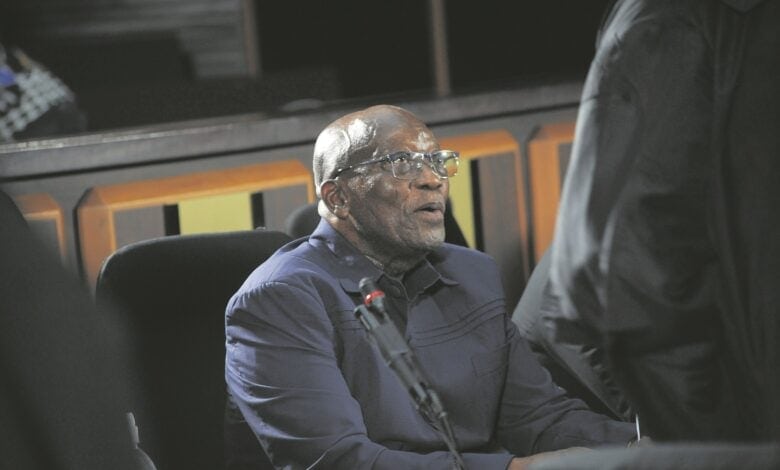
Former president Jacob Zuma has lost his bid to avoid repaying the state R28.9m for his private legal costs, after the court dismissed his application for leave to appeal.
The Witness reports that, according to reports, the Gauteng High Court yesterday refused Zuma’s request to take the matter to either a full bench or the Supreme Court of Appeal, saying he was not convinced that another court would reach a different conclusion.
“To keep the doors of the court open indefinitely to a litigant who refuses to accept a judgment serves no legitimate purpose,” said Judge Anthony Millar.
“It drains scarce judicial resources and entrenches the view that accountability can be deferred for as long as one has the means to do so.”
Meanwhile, in Pietermaritzburg, the high court reserved judgment in Zuma and French arms company Thales’ latest attempt to have their corruption charges withdrawn.
Judge Nkosinathi Chili heard their application for leave to appeal his June ruling, which dismissed their bid for an acquittal in the decades-long arms deal corruption case and effectively cleared the way for the long-delayed trial to proceed.
Alongside the appeal bid, the state also brought what it described as a ‘stop Stalingrad’ application against both accused.
“The state brings this application because of the accused’s ‘Stalingrad’ strategy. The current manifestations of the strategy are their quashing-of-prosecution applications earlier this year, their attempts to seek leave to appeal against the dismissal order, and their opposition to this application,” the state argued.
Zuma and Thales are seeking a permanent stay of prosecution, claiming that the prolonged delays have infringed on their right to a fair trial.
However, in June, Chili ruled that the court had no authority to withdraw charges and was not convinced that the accused would suffer irreparable prejudice.
“It would be incompetent for the court to grant the relief sought,” he ruled at the time, adding that the power to halt prosecutions rests solely with the state.
As a result, Zuma still faces corruption, fraud, racketeering and money-laundering charges linked to the 1999 Strategic Defence Procurement Package, widely known as the arms deal.
He is accused of accepting bribes from Thales while serving as deputy president, with payments allegedly channelled through his former financial adviser Schabir Shaik, who was convicted of corruption and fraud in 2005.
Zuma joined Thales’ application earlier this year, arguing that the state’s case against him is ‘symbiotically conjoined’ with that of the company.
Thales contends that its defence has been severely compromised by the deaths of two key witnesses, former directors Pierre Moynot and Alain Thétard, who both lived in South Africa during the arms deal period.
Moynot died in January 2021, and Thétard in Germany in September 2022.
The company only obtained formal confirmation of their deaths in late 2021 and in 2024, respectively.
In its grounds for appeal, Thales argues that it has demonstrated an inability to challenge crucial state evidence or lead its own evidence on several charges, as these matters fall within the personal knowledge of the deceased witnesses.
The company claims that no other individuals possess that knowledge. While the state has indicated that it will not dispute the admissibility of certain hearsay evidence at trial, it has not conceded the accuracy of that evidence.
Zuma’s application, meanwhile, argues that Chili misapplied the law by elevating the Criminal Procedure Act 51 of 1977 above the Constitution.
His papers challenge Chili’s finding that ‘Section 6 of the Criminal Procedure Act makes it clear that the power to withdraw a charge or stop the prosecution rests with the state’.
Zuma contends that the correct approach would have been for the court to rely on section 172(1)(b) of the Constitution to protect the accused’s section 35(3)(i) fair-trial rights.
“Flowing from the learned judge’s misdirection at paragraph 6 of the judgment, the entire ratio decidendi is premised on erroneous legal propositions and a misapplication of the law. The misdirection can be summed up as a ‘failure to observe and apply constitutional supremacy’, thereby violating section 2 of the Constitution,” Zuma’s application argues.
The judge is set to deliver judgment on January 23, 2026.
Breaking news at your fingertips… Follow Caxton Network News on Facebook and join our WhatsApp channel.
Nuus wat saakmaak. Volg Caxton Netwerk-nuus op Facebook en sluit aan by ons WhatsApp-kanaal.
Read original story on witness.co.za

