
Court battle over TotalEnergies’ West Coast deep-sea drilling project
Environmental groups say TotalEnergies’ ultra-deep-water exploration is not only unlawful but threatens marine life and the livelihoods of small-scale fishers.
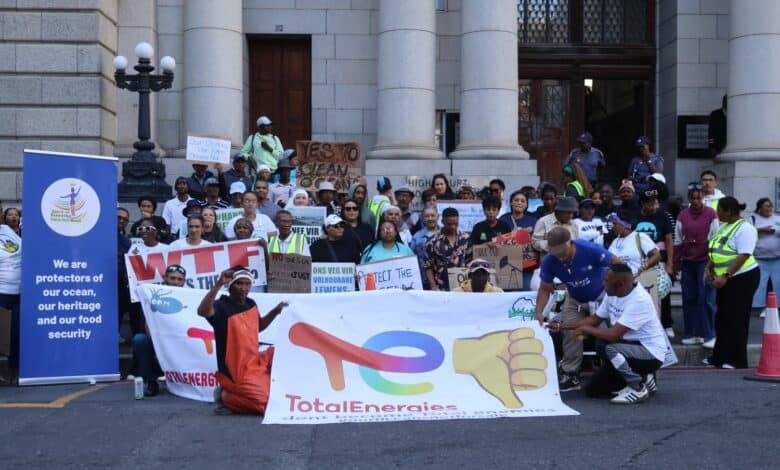
Environmental groups are legally challenging the authorisation granted to TotalEnergies for ultra-deep-water oil and gas exploration in the Deep Western Orange Basin (DWOB) off South Africa’s West Coast.
The case was heard in the Western Cape High Court on Monday and yesterday, with judgment still to be delivered.
The applicants in the matter are Green Connection, Natural Justice and Aukotowa Fisheries Co-operative and the respondents are the Department of Mineral and Petroleum Resources, the Minister of Forestry, Fisheries and the Environment and TotalEnergies.
The case dates back to October 23, 2023, when the then-Department of Mineral and Resources and Energy granted TotalEnergies environmental authorisation for ultra-deep-water exploration drilling in the DWOB.
In a joint statement today, the applicants said that, along with five other appellants, they appealed the decision; however, the appeals were dismissed by the then-Minister of Forestry, Fisheries and Environment on April 24, 2024.
They then approached the high court.
Climate change
The applicants have argued that the approval process was unlawful, irrational and inconsistent with constitutional, environmental and climate obligations.
They asked the court to review and set aside both the director-general’s original decision and the minister’s dismissal of their appeals.
The statement says the court heard arguments about the project’s need and desirability, particularly in light of worsening climate impacts across the country.
The applicants argued that the state adopted an irrational and narrow approach by assessing the exploration phase in isolation.
They maintained that the National Environmental Management Act 107 of 1998 required a lifecycle assessment, which includes the climate impacts of eventual extraction and combustion of the gas.
The applicants argued that the project is incompatible with South Africa’s net-zero commitments, and that the ‘bridge fuel’ narrative, relied on by the state, is outdated and scientifically unsupported.
At a time when the International Court of Justice has made clear that states must avoid significant harm to the climate system, approving new fossil fuel projects is irresponsible, they argued.
Declining fish stocks
Green Connection’s outreach ambassador, Neville van Rooy, says one of the main reasons that they approached the high court is because the DWOB presents conditions unlike anything South Africa has ever faced – both in water depth and technical complexity.
“The environmental impact assessment (EIA) simply did not deal with these heightened risks. We believe that the law supports the rights of small-scale fishers who are already on the frontline of climate impacts, especially since this project introduces new threats that, in our view, were never properly assessed,” adds Van Rooy.
Walter Steenkamp from the Aukotowa Fisheries Co-operative in Port Nolloth says communities along the West Coast are already dealing with declining fish stocks and the growing impacts of climate change.
Effect on livelihoods
“The state failed to meaningfully assess how this project will affect our livelihoods, food security, cultural heritage and constitutional rights – effectively prioritising corporate interests over vulnerable fishing communities,” he explains.
For Steenkamp, their livelihoods depend on the ocean.
“We have the right to be heard and the right to a healthy environment. But the approval process ignored our lived realities and the warnings we have repeatedly raised. We are hopeful that the court will recognise the seriousness of these failures,” he adds.
He emphasised that the EIA appears to significantly downplay the risks associated with drilling at depths greater than 2 000m below sea level – conditions that are entirely unprecedented in this region, he adds.
“Without robust, site-specific scientific evidence and a blow-out contingency plan that has been properly tested in South African waters, the approval of this project violates the precautionary principle, which requires decision-makers to act with heightened caution where activities pose the risk of serious or irreversible harm,” he says.
Safeguard coastal public property
Melissa Groenink-Groves, the programme manager of the Defending Rights Programme at Natural Justice, says this case is fundamentally about whether decision-makers can disregard key environmental laws designed to protect our coastline and the people who depend on it.
“The Integrated Coastal Management Act (24 of 2008) – a central law governing activities in the coastal zone and imposing clear obligations – was overlooked in many respects, and important considerations were left out,” she says.
Groenink-Groves adds that the public trustee duty compels the state to safeguard coastal public property for current and future generations, not hand it over to corporations based on incomplete or inadequate assessments.
Locals make voices heard
Ernest Titus, a resident and fisher from Lambert’s Bay, says the decision will have a major impact on the future of the region’s fishing industry.
“For generations, our families have relied on traditional fishing to put food on the table, and these decisions directly affect our ability to provide for our children and support our communities. The fishing industry plays an important role in South Africa’s economy, yet oil exploration threatens the livelihoods of small-scale fishers,” he adds.
Titus says the risks to marine life and long-term sustainability are simply too great.
“We hope the outcomes will protect our oceans and preserve these resources for future generations,” he adds.
Justin Montzinger, an environmental activist from Port Nolloth, says:
“Our main focus is the ocean, as our lives depend on it. Oil exploration could harm marine life and affect the well-being of our people. We want to ensure a safe and sustainable future for our oceans,” he says.
Andries Booysen from Elandsbaai says the government must consider the impact on small-scale fishers and local communities.
“Our children’s futures and the sustainability of the fishing industry are at risk. We urge the department to stop oil and gas exploration in our oceans,” he says.
An environmental activist and the founder member of Spirit of Endeavour Fisherfolk Women in Doringbaai, Deborah De Wee, says they oppose TotalEnergies and Shell and all ocean-based oil and gas drilling.
“The ocean is the livelihood of indigenous fishers and provides our income and healthy food. Pollution threatens our children, grandchildren and the continuation of our culture. We must protect our oceans for future generations,” she adds.
Energy security
GroundUp reports that yesterday, TotalEnergies’ legal representative, Adv Chris Loxton, argued that South Africa could not simply ‘look the other way’ while other countries explored for oil and gas.
Loxton said the applicants wished for the public and government to remain ignorant of whether South Africa has new sources of energy.
“Ignorance has no advantage,” he said.
Public outcry
Ahead of the hearing, nearly 100 small-scale fishers and coastal community members held a peaceful but spirited demonstration outside the court, supporting the call to the judiciary to overturn the environmental authorisation.
Small-scale fishers and coastal communities organised separate solidarity actions across parts of the Eastern Cape and KZN.
Caxton Network News reached out to TotalEnergies in South Africa for comment.
Baxolile MSOMI, the communications and CSI manager, said: “With regard to the court proceedings, please be advised that the matter is sub judice. Therefore, TotalEnergies in South Africa cannot provide additional commentary. The company remains fully committed to operating in compliance with all applicable local and international regulations everywhere it operates, in line with the highest industry standards.”
*This article was edited after first being published to include TotalEnergies in South Africa’s comment.
Breaking news at your fingertips… Follow Caxton Network News on Facebook and join our WhatsApp channel.
Nuus wat saakmaak. Volg Caxton Netwerk-nuus op Facebook en sluit aan by ons WhatsApp-kanaal.
Read original story on www.citizen.co.za

